

Featured Works
Why Artists Keep Painting Highland Lochs
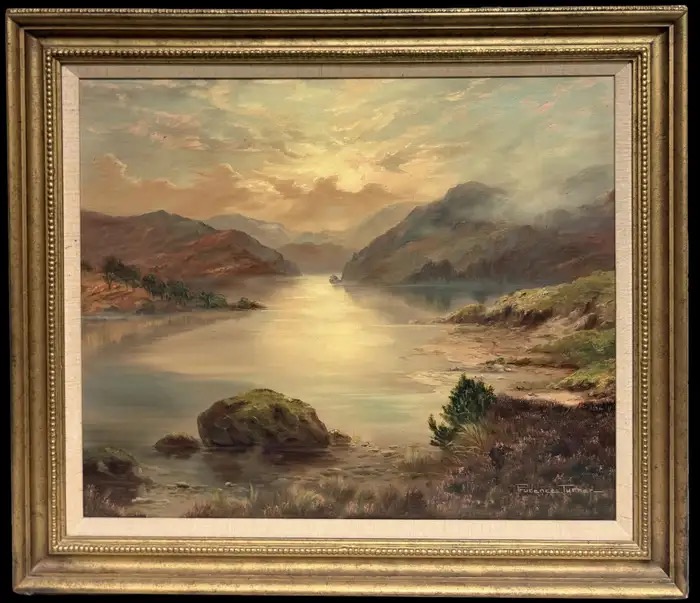
There are certain parts of the Scottish Highlands that artists return to again and again.
Not just the region as a whole, but very specific places. Loch Duich, Loch Broom, Loch Maree, Loch Awe. The same views appear across different paintings, by different artists, often years apart, yet the subject itself remains remarkably consistent.
That repetition is not accidental.

Loch Duich, Ross-shire, Scottish Highland Landscape with Castle Ruins by John Williams (British, exhibited 1831-1876), unsigned. View this piece Here.
Take Loch Duich, for example. In works such as John Williams’ view of the loch in Ross-shire, the structure of the landscape is immediately clear. Water sits quietly in the foreground, the land rises behind it, and the eye is led naturally through the scene. Ruins, cottages, or small details often appear, but they never overwhelm the setting. The composition already does most of the work.
It is a similar feeling in paintings of Loch Broom, particularly those capturing early morning light. In Prudence Turner’s sunrise scene at Ullapool, the subject is not just the place itself, but the moment within it. The light is low, the water holds a reflection, and the atmosphere feels as though it could shift at any point. That sense of timing is something artists tend to return to, especially in Highland settings where the weather and light change quickly.
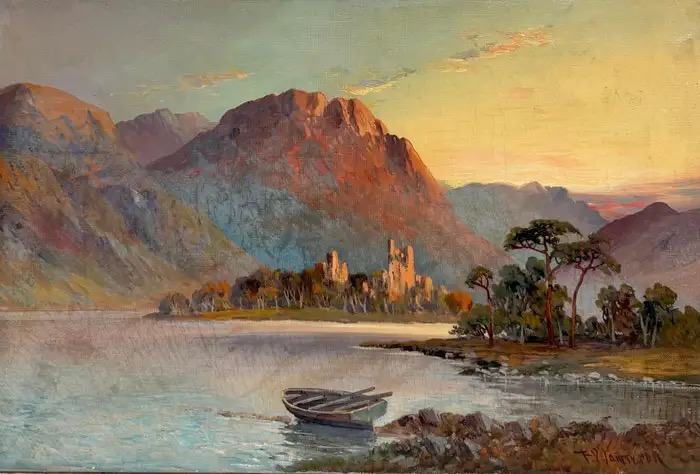
Kilchurn Castle, Loch Awe, signed by F. E. Jamieson (British 1895-1950) View further details of this piece Here.
Sunrise and sunset appear often in these works, and for good reason. The softer light allows for a broader range of colour without losing the calmness of the scene. In paintings of Loch Awe, such as those including Kilchurn Castle, the landscape is given structure by the architecture, but it is the light that gives it atmosphere. The setting becomes less about a specific landmark and more about how the place feels at that time of day.
What ties these scenes together is not just the subject, but the way they create depth. A loch naturally opens up the space. The foreground is often still, the middle distance stretches across the water, and the background recedes into hills or mountains. It is a composition that draws the eye without needing to force it.
You see a slightly different approach in works that introduce a figure. In paintings such as a fisherman on Loch Maree, the landscape becomes less about scale and more about presence. The figure is small, but it anchors the scene. It gives a sense of quiet activity without interrupting the overall calmness.
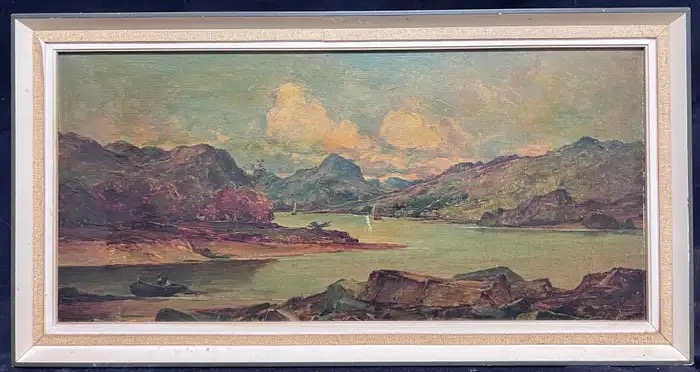
Loch Maree, Scotland By Alex Fraser, Scottish School, 1800-1899 inscribed verso Oil on board. View this piece Here.
That balance is part of what makes these paintings so easy to live with. They are not dramatic in an obvious way, but they hold attention over time. The subject is familiar, the structure is clear, and the atmosphere tends to settle into a space rather than compete with it.
We see this quite often with buyers. Highland loch scenes do not usually divide opinion. They feel recognisable, even to people who have never visited these places, and they tend to work across a range of interiors.
The fact that artists keep returning to the same locations is, in itself, a clue. These are landscapes that offer just enough structure, just enough variation in light, and just enough atmosphere to keep them interesting, without ever feeling overworked.
And that is usually what allows them to hold their appeal.
If you are drawn to Scottish landscapes, you can explore our current selection of Highland and loch paintings on the website, or get in touch if you are looking for a particular location or view.
Click here to view our collection of Scottish landscapes
