

Art & Interiors
How Colour Draws You Into a Painting

People rarely choose a painting by analysing it.
It’s usually quicker than that.
They stop on something. They look a bit longer. And more often than not, it’s the colour that’s done it.
You tend to react before you think
Colour isn’t something most people break down logically.
You don’t usually ask why a certain palette works. You just feel it.
Some combinations feel easy straight away. Others take a bit more time. Occasionally, something stands out that you weren’t expecting to like at all.
That reaction is often the most honest part of the process.

Huge 20th Century French Cubist Abstract Cityscape in Blue. View this piece by clicking here.
Not all colour is immediate
Some paintings rely on impact.
Strong contrasts, brighter tones, something that catches your eye from across the room. You notice them straight away.
Others don’t do that.
They feel more balanced, more restrained. Nothing jumps out at first, but the longer you look, the more you start to see how it’s been put together.
Both approaches work. They just ask for a different kind of attention.
The ones that last aren’t always the loudest
It’s easy to assume that the most striking colour will be the most satisfying to live with.
Sometimes that’s true.
But often, the paintings people hold onto are the ones that don’t reveal everything immediately.
There’s a bit more going on beneath the surface. The colour shifts slightly depending on the light, or how long you spend with it.
They don’t rely entirely on first impact.
You don’t need to “understand” it
There’s a tendency to feel like you should be able to explain why a painting works.
Especially with more abstract or expressive colour.
But it’s not really necessary.
If something holds your attention, or you find yourself going back to it, that’s usually enough.
Trying to put it into words often comes later, if at all.
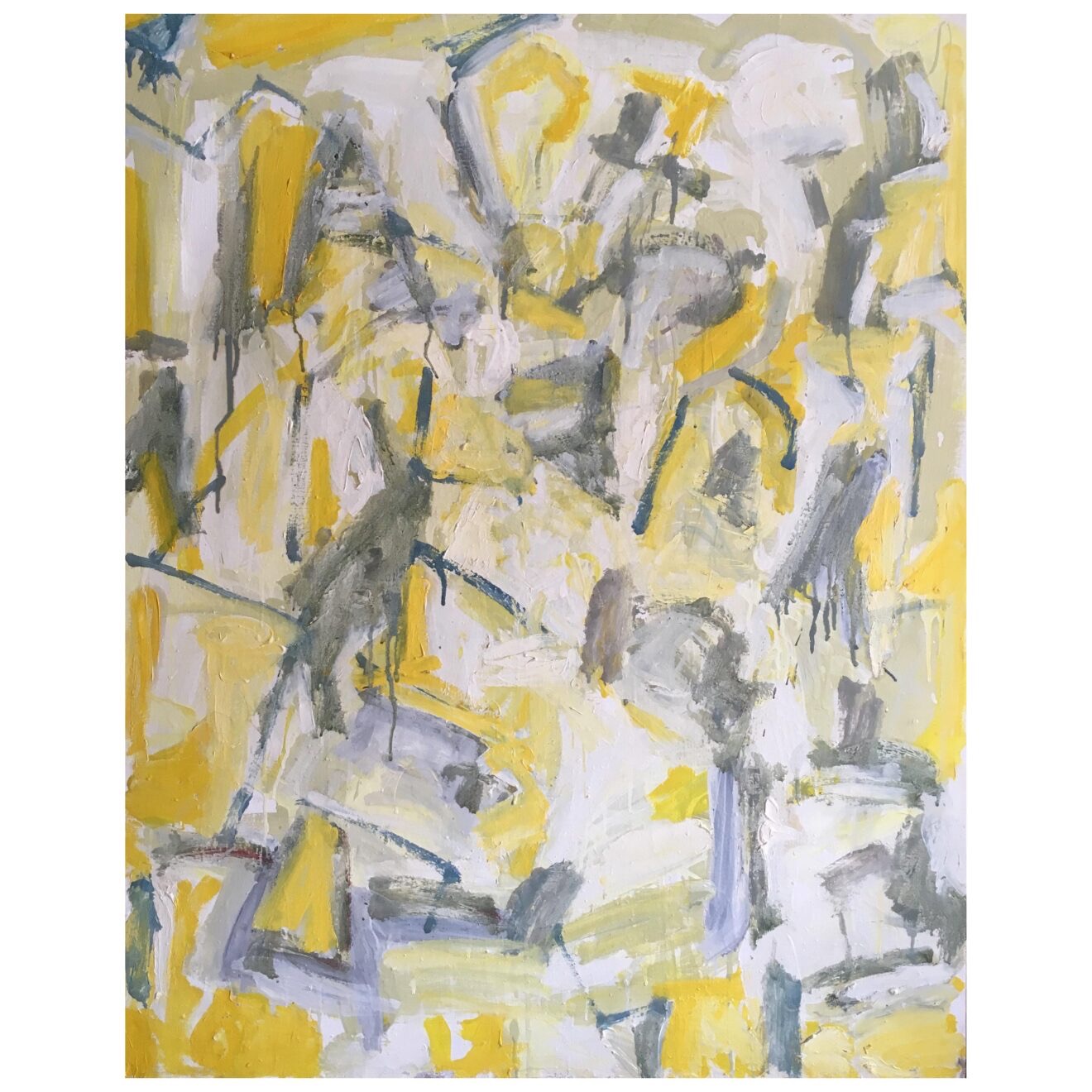
Yellow and Grey Abstract Huge Oil Painting on Canvas Cubist Expressionist work. View further details about this piece Here.
Patterns start to appear over time
If you look through enough paintings, you’ll begin to notice something.
You’re drawn to similar kinds of colour, even across very different styles.
Maybe softer, more muted palettes.
Maybe something brighter, with more contrast.
That consistency is useful. It tells you what you’re naturally responding to, without needing to overthink it.
A simpler way to approach it
Instead of asking whether the colour “works”, it can help to ask something slightly different:
Do I keep coming back to this?
Not just once, but more than that.
Because that’s usually what matters most when you’re choosing something to live with.
It’s more instinct than theory
Colour can be explained in all sorts of ways.
But when it comes to choosing a painting, it rarely comes down to that.
It’s instinctive. Slightly personal. And often difficult to justify in a neat sentence.
Which is why it tends to be more reliable than it first seems.
To browse our collections and find the right piece for you, click here.
